

Time moves quickly in the IoT world. It seems like only five minutes since we launched the Code of Practice on Consumer IoT Security.
The staff in the Secure by Design team at DCMS have been working incredibly hard to move forward on the commitments to explore how to identify to consumers what good looks like when it comes to purchasing a connected product. Alongside this, there have been many discussions on the various different possibilities for regulation.
The Minister for Digital, Margot James has launched a consultation on new laws around the first three items in the Code of Practice – elimination of default passwords, responding to reported vulnerabilities and ensuring that software updates are provided, to a transparent end date for consumers.
The consultation is open until the 5th of June 2019 – views can be emailed to: [email protected] or via post to Department for Digital, Culture, Media and Sport, 4th Floor, 100 Parliament Street, London, SW1A 2BQ.
The consultation states:
“We recognise that security is an important consideration for consumers. A recent survey of 6,482 consumers has shown that when purchasing a new consumer IoT product, ‘security’ is the third most important information category (higher than privacy or design) and among those who didn’t rank ‘security’ as a top-four consideration, 72% said that they expected security to already be built into devices that were already on the market.”
Importantly and one component of what we need to work to solve is this issue:
“It’s clear that there is currently a lack of transparency between what consumers think they are buying and what they are actually buying.”
Identifying products that have been designed with security in mind
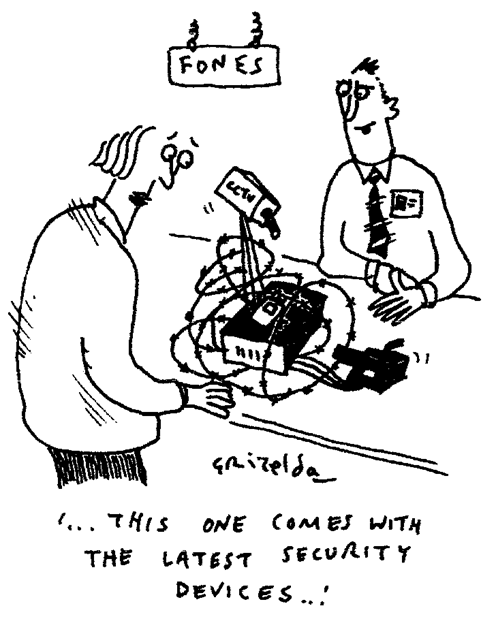
As the cartoon below demonstrates – explaining security to consumers is difficult and could confuse and scare people, so a balance needs to be found. What the government is proposing in its consultation is to provide a label that explains some measurable elements about the security design approach of that product.


So how do you go about identifying how secure something is?
The answer is – with great difficulty. Even more so in the modern world, because the security properties of a device and service are not static.
To explain this a bit further – all technology will contain vulnerabilities that are not known about yet. These could be issues that are known types of security vulnerability, but that are buried and haven’t been caught during the design and testing process. When you have thousands, maybe even millions of lines of code, written by multiple people and from different companies, this isn’t unexpected. For every piece of software there will be a certain number of bugs, some of these will be security vulnerabilities and a smaller sub-set of these will be “exploitable” vulnerabilities – i.e. those that an attacker can use to do something useful (from their perspective!) to the system.
So this shows why software updates are critically important – in fact even some of those bugs that are not exploitable could in the future become exploitable, so deploying software updates in a preventative manner is a hygienic practice. It is a form of inoculation, because we all benefit from systems being patched, it reduces the number of systems that will be impacted in the future and therefore reduces the potency of attacks which have a major global impact. This of course is paramount in the internet of things, because everything is connected and the onward impact on peoples’ lives could become safety-impacting in some way. We have moved past the time where systems being disabled or unavailable were an inconvenience.
So what does a label give us? Well at this stage – what we can do is help a consumer make an informed purchasing decision. Answering questions like “how long does this device get security updates for?” is really useful. It also means that those companies that have no interest in providing updates (even though they’re critical to provide) can no longer hide behind anything. It’s there for the buyer to see – if you don’t provide the updates, the consumer is free to choose not to buy your product. Not really good business to ship rubbish anymore is it?
Regulation of the Code of Practice security measures
The intention by the government is to pass the Code of Practice measures into law over time. On the regulatory side of the top three from the Code of Practice, the government has boiled down the consultation to three potential options:
“
● Option A: Mandate retailers to only sell consumer IoT products that have the IoT security label, with manufacturers to self declare and implement a security label on their consumer IoT products.
● Option B: Mandate retailers to only sell consumer IoT products that adhere to the top three guidelines, with the burden on manufacturers to self declare that their consumer IoT products adhere to the top three guidelines of the Code of Practice for IoT Security and the ETSI TS 103 645.
● Option C: Mandate that retailers only sell consumer IoT products with a label that evidences compliance with all 13 guidelines of the Code of Practice, with manufacturers expected to self declare and to ensure that the label is on the appropriate packaging.
“
From a personal perspective, I find it fantastic that we’ve reached the point where we can get rid of a lot of the products that are blighting the market with blatant insecurity. Good riddance I say and let’s celebrate the companies that are really paying attention to consumer security.
The security label will be run on a voluntary basis by retailers until regulation comes into force and legislative options are taken forward. The consultation also includes example designs that could be used. Interestingly when DCMS carried out a survey into what types of icons would be best, a padlock option was selected by less than 1% of participants. To me, what this reflects about the state of browser and web security and how we communicate security to users is somewhat depressing, but it serves as a reminder that trust is hard to earn, but easily lost.
This work is just another step down the road for globally improving IoT security. Again, it’s not the be all and end all, but it is a positive step and yet another example that the UK is leading the world by taking action, not just talking about IoT security.