
The rise of SpamGPT
Phishing is not new. But SpamGPT has changed the game by showing how AI can industrialize deception at scale.
SpamGPT has quickly become the poster child for how attackers are using AI to industrialize old tricks. At its core, SpamGPT isn’t introducing a new kind of attack; it’s simply making phishing faster, cheaper, and more convincing.
Phishing has always been about deception. But with AI generating endless, polished, and context-aware lures, the balance of power shifts. For the first time, it’s not just humans trying to trick humans. It’s AI versus human.
This blog examines how SpamGPT is transforming the security landscape, why traditional defenses are no longer sufficient, and what organizations must do to stay ahead of the curve.
Key takeaways
- SpamGPT proves humans can’t outsmart AI phishing at scale.
- The fight is now AI vs. AI, not AI vs. human.
- Phishing is expanding beyond email to SMS, apps, and push notifications.
- Automated defenses + offensive security are essential.
- Winners will harden apps, enforce zero trust, and simulate AI-scale threats before attackers do.
Why humans can’t win this fight
Traditional defenses against phishing leaned heavily on human vigilance. We trained employees to look out for bad grammar, odd links, or suspicious sender addresses. That worked when phishing campaigns were sloppy and inconsistent.

SpamGPT changes that. AI-generated phishing:
- Removes the tell-tale grammatical errors.
- Personalizes messages at scale.
- Floods inboxes with endless variations, overwhelming filters, and employees alike.
SpamGPT doesn’t reinvent phishing—it supercharges it:
- Faster: Thousands of personalized lures in seconds.
- Cheaper: No need for human “scammers” writing emails.
- More convincing: Flawless grammar, context-aware, customized.
The result? Phishing at AI speed and scale.
Expecting humans to spot AI-generated deception reliably is unrealistic. People make mistakes, especially when distracted, rushed, or working on small mobile screens. In an AI-driven threat landscape, the “human firewall” model collapses.
The real battle: AI vs. AI
If attackers are using AI to scale deception, defenders have to use AI to scale detection. The true security equation is no longer AI vs. human, but AI vs. AI.
This shift means:
- Automated phishing detection that adapts in real time.
- AI-powered anomaly detection to flag suspicious behaviors.
- Automated response systems that can block or quarantine threats before employees ever see them.
Training still has value, but it cannot be the core defense strategy.
SpamGPT proves that point solutions—such as awareness campaigns, filters, or one-off security tools—crumble under the weight of AI-scale deception. Systemic resilience, built on automation, layered defenses, and secure-by-design applications, is what separates businesses that stay protected from those that get breached.
Beyond email: The expanding battlefield
SpamGPT is getting attention for email phishing today, but it won’t stop there. Attackers go where users spend their time, and that increasingly means mobile-first channels.
Tomorrow’s AI-powered phishing will look like:
Smishing (SMS phishing)
AI-crafted texts designed to mimic delivery services, banks, or HR portals.
App phishing
Malicious clones of legitimate apps, complete with AI-written app store descriptions.
In-app deception
Fake push notifications or chat prompts that trick users into entering credentials.
SpamGPT is just the beginning. Once AI proves it can scale email phishing, the same techniques will spill into every channel we trust.
Summary table: SpamGPT & AI phishing risks
|
Threat vector |
How SpamGPT amplifies it |
Real-world impact |
Defense strategy |
|
Email phishing |
Perfect grammar, endless variants |
Training fatigue, bypassed filters |
AI-based anomaly detection |
|
SMS (Smishing) |
Mimics banks & services via SMS |
Credential theft, fraud |
Mobile threat defense + MFA |
|
App phishing |
Fake apps with AI-written listings |
Rogue installs, data theft |
App vetting + runtime protection |
|
In-app deception |
Fake notifications & prompts |
Stolen OTPs, account takeover |
Harden app workflows + zero trust |
Offensive security: The next step forward
SpamGPT also underscores the importance of active defense.
If attackers are already using AI to probe weaknesses at scale, businesses need to get ahead by doing the same.
Offensive security – penetration testing, red teaming, and phishing simulations – allows organizations to:
- See what attackers see.
- Expose systemic gaps before they’re exploited.
- Validate whether automated defenses actually work under AI-scale pressure.
Relying solely on passive defense is no longer enough.
SpamGPT proves the game is now one of speed and scale. Active defense is a method by which organizations train their systems to withstand the same tactics that real attackers are likely to use.
The road ahead
SpamGPT is a wake-up call. It indicates that attackers will utilize AI to enhance existing exploits, rather than invent new ones. The businesses that still rely on people to spot attacks will be outmatched.
The future of security is clear:
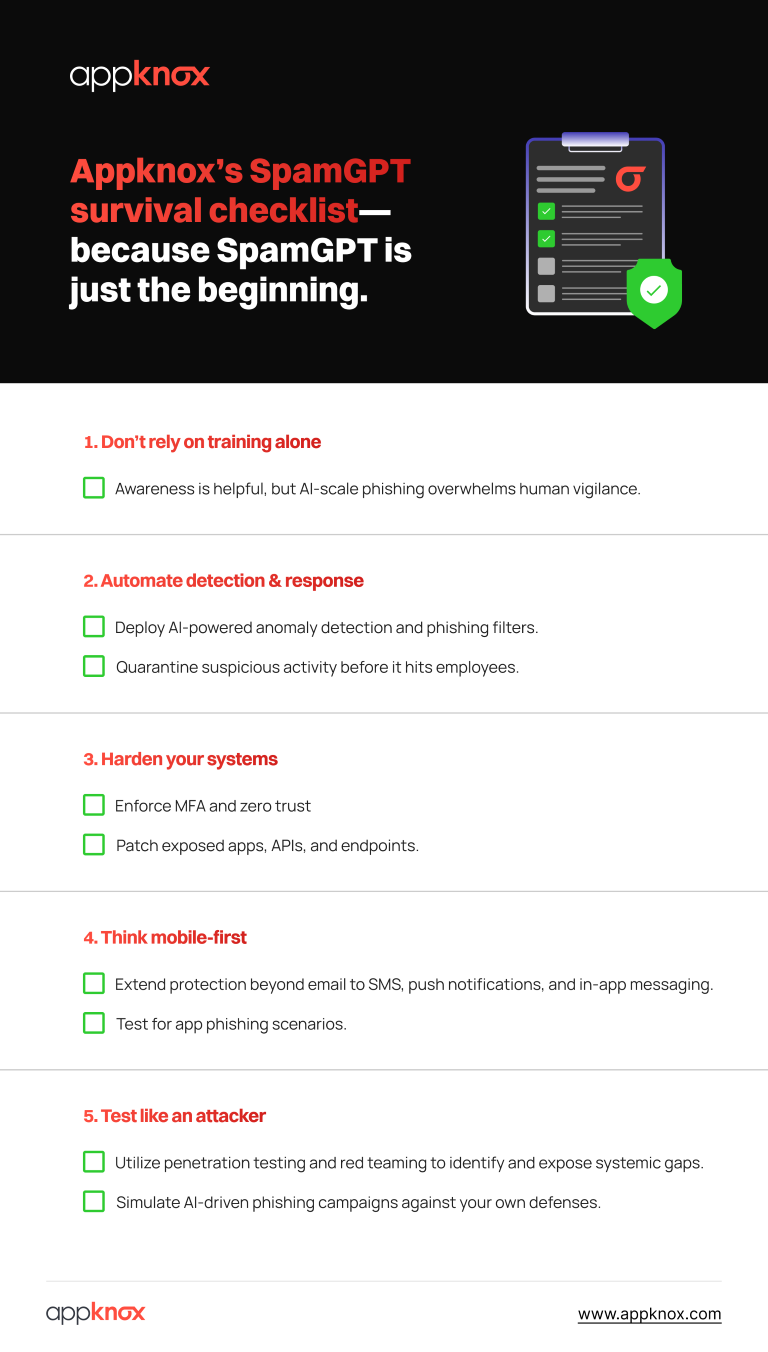
- Stop asking humans to fight AI alone.
- Build automated defenses that meet AI with AI.
- Harden apps and systems so there’s nothing for attackers to exploit when lures succeed.
- Utilize offensive security to stay one step ahead by continuously testing defenses against the same tactics that attackers use.
Final thought
The battle isn’t really AI vs. Human, it’s AI vs. AI, with humans setting the rules.
The organizations that embrace automation, systemic resilience, and offensive security will stay ahead. Those who don’t will find out the hard way what happens when machines overwhelm people.
At Appknox, we help businesses test, secure, and harden their mobile apps against exactly this kind of scale-driven threat. Because SpamGPT is just the beginning, and the next wave of phishing won’t stop at the inbox.
Frequently Asked Questions
1. What is SpamGPT?
SpamGPT is an AI-powered phishing tool that generates realistic, scalable phishing campaigns faster and more convincingly than human attackers.
2. Why can’t humans stop AI phishing?
AI removes tell-tale signs like bad grammar. Employees are distracted, rushed, and on mobile devices—making it nearly impossible to spot phishing.
3. What’s the best defense against SpamGPT?
AI-driven detection, automated response, and continuous offensive security testing.
4. Why is mobile phishing the next considerable risk?
As users shift to SMS, apps, and in-app notifications, attackers follow suit. Mobile-first phishing is already accelerating.